
Every restaurant deserves a free POS.
We get paid per order — not per merchant.
Tastie gives restaurants the full stack — QR ordering, kiosks, a free website, pickup, delivery, accounting and AI tools — at no monthly cost. We earn small, volume-based fees on every order: the more our merchants grow, the more we make.
What we build for restaurants
One free platform replaces the POS subscription, the ordering tablet, the delivery marketplace commission and the web agency. That breadth is our wedge.
QR table ordering & live bills
Guests scan, order, and the bill updates live on the merchant POS. No hardware, no app.
Tablet kiosks
PIN-locked dine-in and to-go kiosk modes turn any cheap tablet into an ordering station.
Free SEO website per restaurant
Every merchant gets a public, search-optimized website with menu, photos and online ordering.
On-demand delivery
Merchants dispatch DoorDash Drive couriers per order — customers pay the courier fee.
Accounting & expenses
AI invoice extraction, revenue reports, sales charts, and printable bills.
Smart alerts
AI watches margins, menu dead-weight, peak hours and demand trends, then tells the owner what to do.
AI recipe lab
Recipe suggestions generated from each restaurant’s own sales data and customer tastes.
Trilingual by default
English, 中文, Español — for merchants, staff and customers alike.
See it in action
The product is live today — real restaurants take real orders on it. A quick look at the screens that matter.

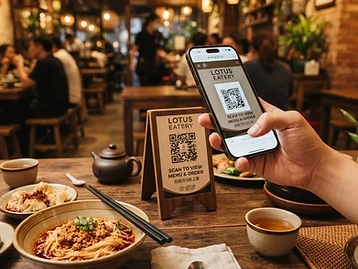
QR table ordering
Guests scan the code on the table and order instantly — the bill lands on the merchant’s dashboard in real time.

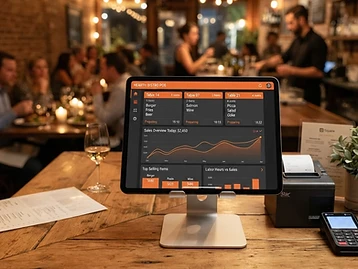
Merchant POS dashboard
The live dashboard where orders arrive, with status controls, delivery dispatch and voice announcements for every new order.

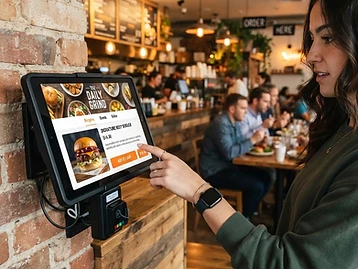
Self-serve kiosks
Any cheap tablet becomes a dine-in or to-go ordering station, PIN-locked so staff stay in control.

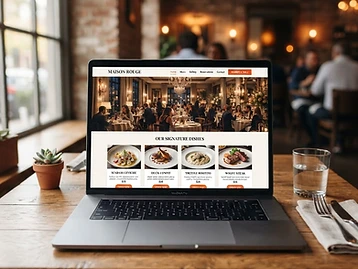
Free SEO website
Every restaurant gets its own public website with menu, photos and online ordering — built and published in one click.
A fair model: free for merchants, profitable for us
No monthly fees, no commissions on food. Three small, compounding revenue streams that only grow when our merchants grow.
Per-order fee
$0.15 per transaction, falling automatically as a merchant’s average daily order volume grows — down to $0.07. Merchants love it: their cost per order drops as we help them sell more.
Delivery markup
$1 added on top of every Uber/DoorDash courier fee, paid by the customer. The merchant keeps 100% of the food revenue — versus the 15–30% commission delivery marketplaces charge.
Payments share
Merchants connect their own Stripe account — money goes straight to them. We add 1% on top of Stripe’s fee for card orders paid through Tastie checkout, so we earn on every online payment.
Volume tiers — average daily orders
| Avg. daily orders | Fee per order |
|---|---|
| 0 – 149 | $0.15 |
| 150 – 299 | $0.10 |
| 300 – 499 | $0.09 |
| 500 – 999 | $0.08 |
| 1,000+ | $0.07 |
Our fee falls as merchants grow
Monthly software fees (per location)
Typical entry plans · Tastie charges $0 base software
Merchant cost on a $30 online order
Commission models vs. Tastie



A massive market that still pays for POS
Independent restaurants are the backbone of a $1.1 trillion industry — and the least served by technology. They pay subscription software they can’t afford and lose 15–30% of every online order to marketplaces.
Restaurant technology spend keeps compounding
US restaurant software & technology spend, $B (2027–29 projected)
Our beachhead
We start where the pain is sharpest and word-of-mouth is strongest: independent, often immigrant-owned restaurants — starting with Asian cuisine, the segment Chowbus proved investors will fund at scale. These owners need trilingual software, cheap tablets instead of $1,000 terminals, and hate monthly fees.
From there, the free POS expands to every independent restaurant category — diners, taquerías, cafés, bakeries — segments the incumbents monetize with monthly plans and proprietary hardware.
How we compare
| Platform | Monthly software | Per-order economics | Free website + SEO | Hardware |
|---|---|---|---|---|
| TastieUs | $0 | $0.15 → $0.07/order · 0% commission | Any device | |
| Toast | $69–$165+ | Processing ~2.99% + 10¢ | Proprietary terminals | |
| Square for Restaurants | $0–$195 | Processing 2.6% + 10¢ | Optional hardware | |
| Clover | $55–$115+ | Processing ~2.6% + 10¢ | Proprietary terminals | |
| Chowbus | $0 software | 15–30% commission per order | Provided tablet | |
| DoorDash / Uber Eats | $0 | 15–30% commission per order | Marketplace tablet |
Competitor figures are representative of publicly listed entry pricing and may vary by plan and region.

Projections: $15M+ revenue in 2028
A disciplined, assumptions-driven path. We are aiming for more than $15 million of annual revenue by 2028 — built merchant by merchant, order by order.
Projected annual revenue
$M · the dashed line marks our $15M target
2028 revenue mix
$M by stream
The math behind 2028
- · 6,000 active merchants by end of 2028 (150 → 900 → 3,000 → 6,000)
- · Average 40 orders per merchant per day
- · Blended per-order fee of $0.09 across volume tiers
- · 20% of orders paid via Tastie card checkout · $30 average ticket · our 1% share
- · 3% of orders delivered with our $1 courier-fee markup
Conservative by design: it excludes future streams (ads, financing, premium AI tiers) and assumes modest payments and delivery attach rates.
Why invest in Tastie
Free wedge wins distribution
A restaurant can sign up and take its first order in minutes, at no cost. Free removes every objection in the sales cycle — our CAC drops while incumbents pay for terminals and lock-in contracts.
Revenue that compounds with merchant success
We only earn when orders happen. Every new merchant starts near-zero cost to us and grows into $250–$500+ of monthly revenue across our three streams.
Three stacked income streams
Per-order fees, a 1% payments share, and a $1 delivery markup on the same order — without ever taking a commission on food.
An AI moat incumbents can’t copy cheaply
Smart alerts, AI insights, invoice extraction and a recipe lab trained on each restaurant’s own data make Tastie more useful every week a merchant stays.
Where your investment goes
Planned use of funds
Why we need your support
The product is built and live. What limits us now is reach: incumbents outspend us on every Google search a restaurant owner types. Most of this raise goes straight into marketing — search and social campaigns targeting restaurant owners, field sales in restaurant-dense metros, and partnerships with supplier and delivery networks — so we can sign merchants faster than incumbents can respond.
Your capital converts directly into merchant growth, and merchant growth converts directly into revenue. With your support, we can accomplish our 2028 target efficiently — and beat the subscription giants to the independents they’ve been overcharging for years.
Watch the product in motion
A short visual walkthrough of the platform, produced by our team.
The team behind Tastie
A team rooted in restaurants and technology, bringing a free POS to every independent restaurant.


Max Fong
Founder and CEO
Option 2: Short & Punchy Founder Bio (LinkedIn / About Us) Max Fong | Founder & CEO, Tastie.food Max Fong bridges the gap between traditional food service and modern software engineering. Growing up managing operations in his family’s Hong Kong restaurants from the age of 11, Max understands the financial pressures kitchen operators face. Combining a background in Finance from Baruch College with years of hands-on experience running a computer electronics import-export enterprise, Max developed deep expertise in computer programming and technical hardware architecture. He founded Tastie.food with a single mission: leveraging modern engineering and AI to help restaurants streamline operations and save thousands in unnecessary software costs.

Zhenni Jackson
Founder and COO
Zhenni has spent her career figuring out one thing: what makes people say yes—and what makes them come back. She learned the art of selling at Saks Fifth Avenue, where she helped Clé de Peau Beauté achieve some of the fastest sales growth in North America. But her real lesson wasn’t about beauty products. It was about people: listen closely, understand what they actually want, earn their trust, and make the experience memorable. She later put that philosophy to work as the founder of Gingie Spa & Massage, building a customer-obsessed service business from the ground up and earning recognition as the 2022 Business of the Year from the Beachwood Chamber of Commerce. Along the way, she learned firsthand what every local business owner knows: getting customers through the door is hard; turning them into regulars is the magic. Zhenni then took her sales and entrepreneurial instincts into B2B technology. As Co-Founder & CEO of opAIda, she works with enterprise customers to bring AI into complex real-world workflows—giving her a front-row seat to how technology can transform the way businesses connect, operate, and grow. She holds an MBA from Fordham University and is a graduate of the Goldman Sachs 10,000 Small Businesses program. Now, as a Founder of Tastie.Food, Zhenni is bringing all those to the table: sales, hospitality, customer experience, entrepreneurship, B2B, and a lifelong love of bringing people together. Food has always had the power to bring people together— tastie.food, one table, one meal, one shared experience at a time.